Nina Wiedemann received dissertation award


Nina Wiedemann, a postdoctoral researcher at the MIE Lab, has been awarded the Förderpreis Geoinformatik by Runder Tisch GIS e.V. for her dissertation titled “Spatio-temporal effects in GeoAI: from predictability to evaluation.”
She presented her work at the Münchner GI Runde on March 19, where she was selected as the award recipient by an independent jury.


New paper in Applied Energy: V2G4Carsharing – A simulation study for 2030

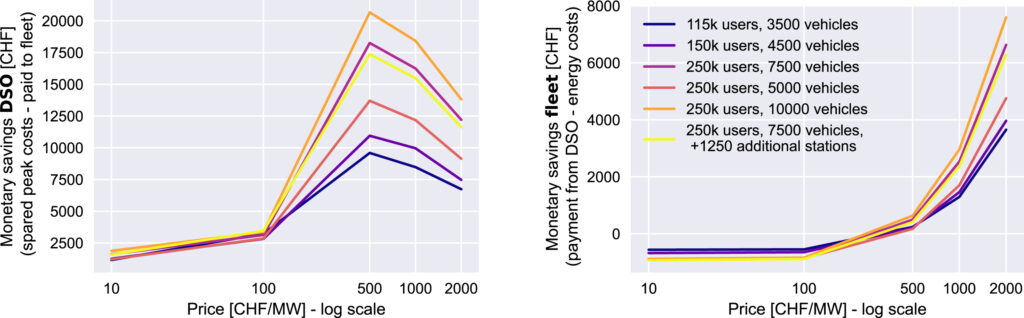
What is the potential for integrating vehicle-to-grid with car sharing in the future? As part of the V2G4Carsharing project, we simulated scenarios for 2030 and quantified the benefits in terms of monetary savings and peak shaving effect. In our case study done in collaboration with the swiss car sharing provider Mobility, we found that Mobility could offer flexibilities between 12 to 50 MW, dependent on the scenario. There is a sweet spot where both car sharing and power grid operators benefit.

Our paper titled Vehicle-to-grid for car sharing – A simulation study for 2030 was now published in Applied Energy! Check out the paper here.

Get in touch if you are interested to learn more, or checkout our project code base and the car sharing simulator.

New Paper in Transportation Research Part C: Quantifying the Dynamic Predictability of Train Delays

Our paper on “Quantifying the dynamic predictability of train delay with uncertainty-aware neural networks” has been published in Transportation Research Part C!

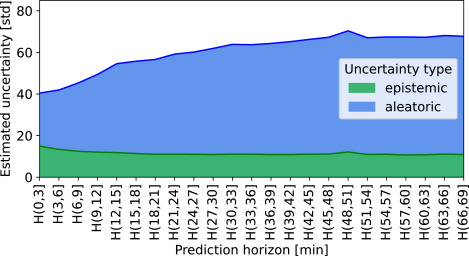
In light of the importance of accurate delay prediction for transport services and passengers, many predictive methods have been proposed. However, they hardly account for the involved uncertainty and there is a lack of work analysing the dynamic predictability over time. We fill this gap with an uncertainty-aware neural network and a framework for describing the predictability by the prediction horizon. The results on Swiss train delay data show 1) an exponential decay of the predictability by the horizon, 2) a significant portion of (aleatoric) data uncertainty in contrast to model uncertainty, and clear advantages of the NN compared to MC models.

For more details, check out our paper! This work was done in collaboration with the Institute for Trans­port Plan­ning and Sys­tems at ETH Zurich.

New paper in the Journal of Big Data: Where you go is who you are

Location data is extremely sensitive, revealing where we spend how much time, what we like to do in our free time, and how we spend our money. Our new study titled “Where you go is who you are – A study on machine learning based semantic privacy attacks” sets out to answer a critical question: Just how much “semantic information” – that is, detailed and potentially sensitive insights into personal behavior – can be extracted from someone’s location data using machine learning techniques, especially when this data might be inaccurate or incomplete?

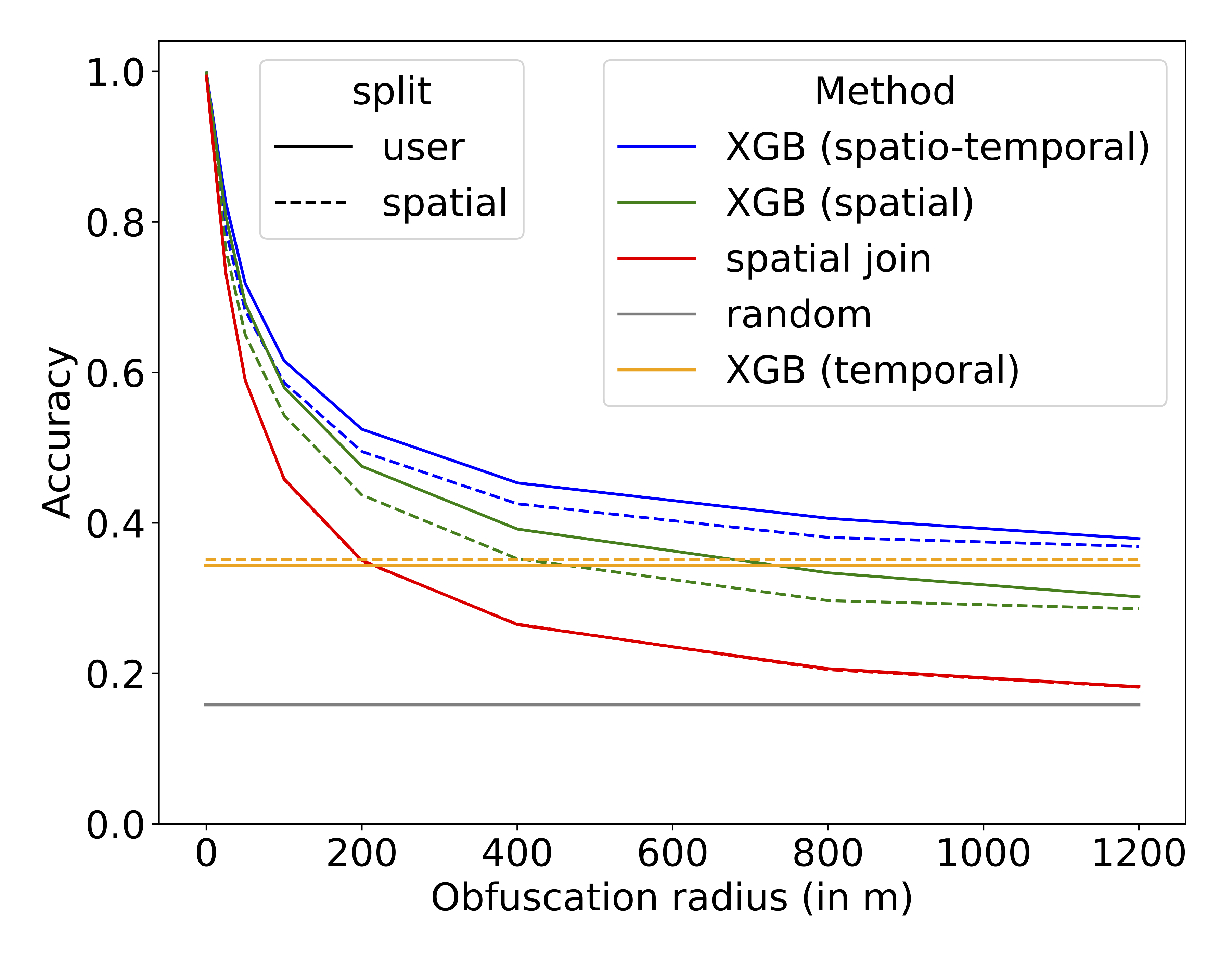
To address this question, we conducted a study using a dataset of location visits from a social network, Foursquare, where the category of the location (e.g., “dining” / “sports” / “nightlife”) is known. We simulate the following scenario: An attacker only knows the geographic coordinates and time of a location visit, and trains a machine learning model to infer the place category. Crucially, the geographic coordiates can be imprecise due to GPS inaccuracies or protection measures. This is simulated by obfuscating the true geographic coordinates with varying radius.

Our experiments reveal a significant privacy risk even with imprecise location data. Although the accuracy of the attacker decreases exponentially with the obfuscation radius, there remains a high privacy loss even if the coordinates are perturbed by up to 200m. A certain risk remains from the temporal information alone. These findings highlight the privacy risks associated with the growing databases of tracking and spatial context data, urging policy-makers towards stricter regulations.

Check out our paper and source code!

New paper published in the Journal of Transport Geography – Car sharing demand prediction

Our paper titled “Spatially-aware station based car-sharing demand prediction” is now published open-access in the Journal of Transport Geography!

In this paper, we analyze long-term station-based car-sharing demand (i.e., the monthly number of reservations per station), and fit local and global models to the demand. Spatially-aware models and methods for interpretability improved our understanding of the effect of different features in varying locations. Our models can assist in planning new car sharing stations, an important avenue towards more sustainable transportation.

This work is part of the Vehicle-to-grid for Car Sharing project.

New paper in Transportation Research Part D – Time flexibility of car sharing users

Our paper titled “Vehicle-to-grid and car sharing: Willingness for flexibility in reservation times in Switzerland” presents the results of a stated preference survey conducted with 777 Mobility car sharing users in Switzerland. This study was part of our Vehicle-to-grid for Car Sharing project, funded by the Swiss Federal Office of Energy, where we aim to analyze the potential of integrating V2G in car sharing services. Understanding the time flexibility of car sharing users is crucial for designing dynamic pricing strategies, for example with the goal to incentivize users to shift their reservation times and thereby to increase the flexibility for V2G.
We found the value of time to be 31CHF/h on average, where older adults, lower income groups and employed adults tend to have lower flexibility. For more details, see our paper published in Transportation Research Part D.

New IJGIS Paper is online – using context data to improve traffic forecasting

Our new paper entitled “Incorporating multimodal context information into traffic speed forecasting through graph deep learning” is now online at IJGIS.

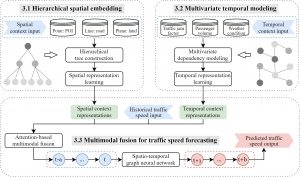
In this work, we propose a multimodal context-based graph convolutional neural network (MCGCN) model to fuse context data into traffic speed prediction, including spatial and temporal contexts. The proposed model comprises three modules, i.e., (a) hierarchical spatial embedding to learn spatial representations by organizing spatial contexts from different dimensions, (b) multivariate temporal modeling to learn temporal representations by capturing dependencies of multivariate temporal contexts and (c) attention-based multimodal fusion to integrate traffic speed with the spatial and temporal context representations for multi-step speed prediction. We conduct extensive experiments in Singapore. Compared to the baseline model (STGCN), our results demonstrate the importance of multimodal contexts with the mean-absolute-error improvement of 0.29 km/h, 0.45 km/h and 0.89 km/h in 30-min, 60-min and 120-min speed prediction, respectively. We also explore how different contexts affect traffic speed forecasting, providing references for stakeholders to understand the relationship between context information and transportation systems. Check out the open-access paper online!

Paper published in the Journal of LBS

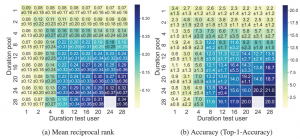
Our paper titled “Influence of tracking duration on the privacy of individual mobility graphs” was published by the Journal of Location Based Services! In this work, we use a GPS tracking dataset and analyze how the tracking duration affects the risk for users to be re-identified; i.e., by matching to previously stored tracking data. It is well known that the tracking data of a user is quite unique and can be matched to stored data easily; however, we study the risk of a representation of tracking data that is already privatised, namely so-called location graphs. Location graphs do not reveal the geocoordinates or time stamps of the places that a user visited, but just the topology of the mobility behaviour. Nevertheless, users can be re-identified with a top-1 accuracy of up to 20%, and the re-identification risk strongly depends on the tracking duration of the user, as well as the duration of the stored data (pool), as shown in the figure below. Check out our paper and code for more information!

Welcome Ayda Grisiute to MIE Lab!

Ayda Grisiute joins MIE Lab on May 1st as a Ph.D. student. Before joining MIE Lab, Ayda worked as a researcher at Singapore-ETH Centre for the Cities Knowledge Graph project. Ayda has a background in architecture and city planning. She received her master’s degree in Architecture from Aalto University, Finland, and her bachelor’s degree in Architecture from Vilnius Academy of Arts, Lithuania. In her previous studies, Ayda focused on algorithmic and data-driven design methodologies. Ayda is excited about urban knowledge management and representation with graphs and she is looking forward to an amazing journey at MIE Lab. We are happy to have her join the team!